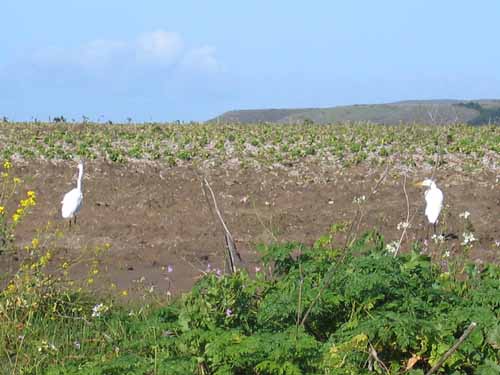
Great Egret
Ardea alba
Overview
Key Features:
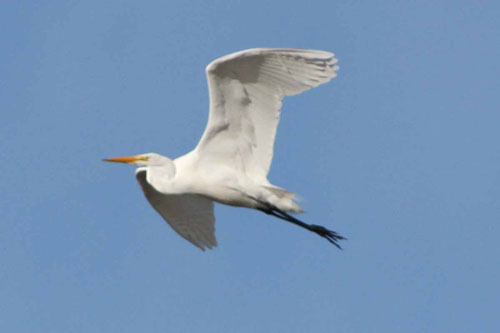
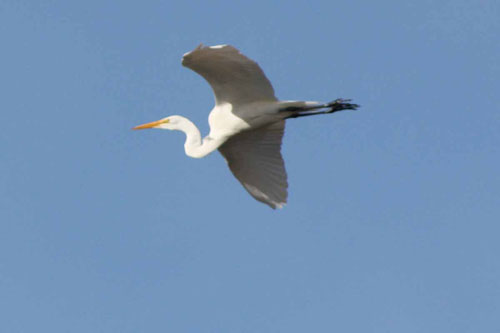
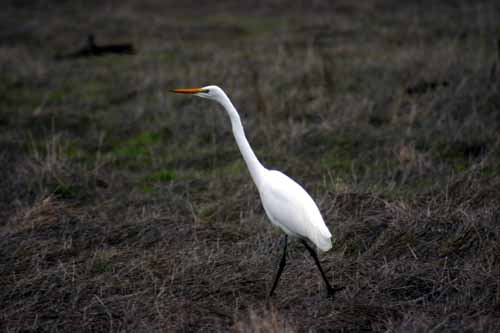
Large, all white, long black legs and feet, and long, sturdy yellow bill. Slow flight, with neck retracted in an S-curve.Similar Species:
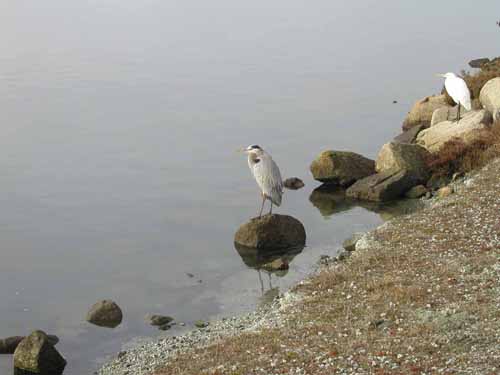
Snowy Egret (Egretta thula)Great Blue Heron (Ardea herodias)
Primary Common Name:
Great EgretGeneral Grouping:
Seabirds and shorebirdsGeographic Range:
Tropical and warmer temperate regions of the world.
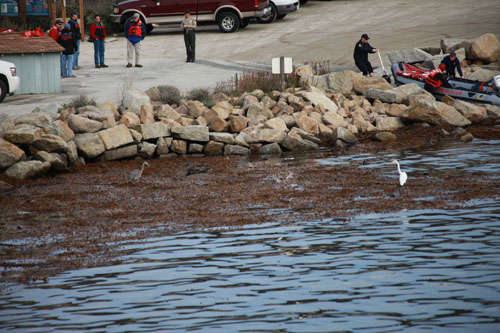
Ardea alba is found in most tropical and warmer temperate regions of the world, from southern Canada southward to Argentina and in southern Europe, Asia, Africa, Australia and New Zealand. They often gather in loose flocks. Northern hemisphere birds are migratory, moving south from areas with cold winters.In the MBNMS area, from August through March, the Great Egret is a common non-breeding visitor to Elkhorn Slough and less common at interior freshwater marshes like Lake San Antonio. From April through July they are fewer in number. The San Francisco Bay area also has a breeding colony.
Habitats:
bay (rocky shore), bay (sandy shore), estuary, protected rocky shoreNotes:
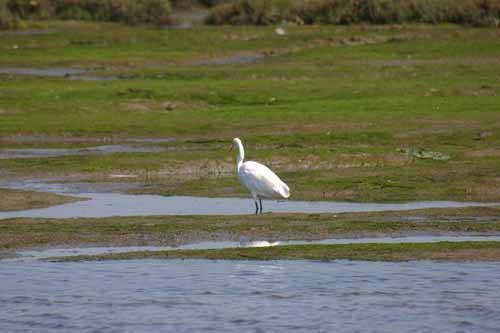
The Great Egret prefers shallow waters (e.g., bays, estuaries, and freshwater habitats), preying on small fish, or land where frogs and insects can be speared with its long, sharp bill.Abundance:
Relative Abundance:
The Great Egret is a common species, usually easily seen in the MBNMS area from August through March, especially at Elkhorn Slough and inland lakes like Lake San Antonio. From April through July they are fewer in number. In the late 1800's and early 1900's North American populations were reduced by more than 95% by plume hunters. After plume hunting was banned by law populations recovered. They were threatened again when the pesticide DDT was used in the agricultural industry in the late 1940's, 1950's, and 1960's. Since DDT's ban in 1972 the population again recovered. No population is considered threatened at this time, but they are vulnerable to the loss of wetlands. The Great Egret is the symbol of the National Audubon Society, one of the oldest environmental organizations in North America. In 1905 The Audubon Society was incorporated in New York State, in part to protect birds from being killed for their feathers.Species Description:
General:
The Great Egret is a large, all-white heron often a meter (3 ft) in height and up to 1 kg (~3 pounds). It has a long (, stout, straight, sharp yellow bill, and long black legs and non-webbed feet with very long toes. When in breeding plumage delicate, lacy, and long feathers appear on the back, curling over the tail. These plumes are extended when in a mating display. At the height of their breeding season, the bill becomes orange-yellow and the lores (area between the eye and the bill) become lime-green. Males, females, and juveniles (except for lack of display plumes and breeding coloration) all look the same.It is sometimes confused with the closely related Great White Heron, which is a white morph of the Great Blue Heron (Ardea herodias).
Distinctive Features:
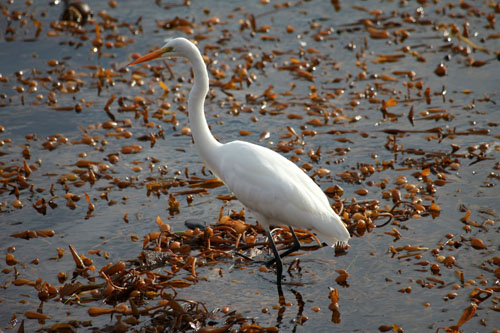
The Great Egret is all white, large, long necked, and long legged. It has a long, sharp, sturdy yellow bill with a dark top edge and long black legs and feet with long, non-webbed toes. Foraging birds are usually wading, standing tall and still for long periods of time, and walking slowly.Size:
• Length: 94-104 cm (37-41 in) • Wingspan: 131-145 cm (52-57 in) • Weight: approximately 1000 g (35.3 ounces)Natural History:
General:
The Great Egret is a large white wading bird with long legs and a bill made for spearing prey in shallow waters of salt or freshwater marshes, ponds and tidal flats. They are graceful birds and their beautiful feathers put them in great jeopardy when collection of feathers for ladies hats was in vogue and legal in the late 1800's and early 1900's. They were also threatened by DDT when their clutch (number of eggs) and brood (number of chicks) size was declining. Since DDT was banned in 1972 their numbers have increased. Northern hemisphere birds migrate south in the winter. They breed in colonies of from 10 to 1,000, usually building a bulky nest of sticks in trees close to lakes with reed beds or extensive wetlands. The female Great Egret lays three to five pale green-blue eggs which are incubated by both parents for about 23 to 26 days. If any of the first eggs are damaged replacement eggs will be laid. At hatching the chicks are covered in long white down and are able to hold their head up just after hatching. Both parents feed the chicks at the nest site for 6 to 7 weeks until they fledge. They are generally not vocal, but at breeding colonies they give a loud croaking cuk cuk cuk. They adapt easily to human habitation and can be found in urban and suburban areas that have bodies of water or wetlands. The longevity record for a wild Great Egret is 22 years.Predator(s):
Adult Great Egrets have no non-human predators and now have some legal protection (Migratory Bird Treaty Act) from humans, although loss of habitat is increasingly a problem. Eggs and nestlings have numerous predators including crows (Corvidae), vultures (Cathartidae), and raccoons (Procyon lotor).Prey:
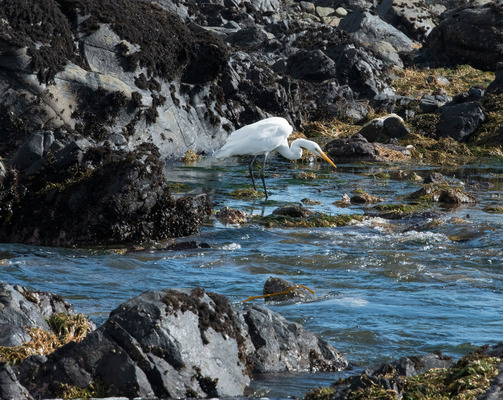
Fish, invertebrates, amphibians, reptiles, birds, and small mammals.The Great Egret feeds alone in shallow water. It stalks prey like frogs, crayfish, snakes, snails and fish. When it spots its prey, it pulls its head and long neck back and then quickly stabs the prey and swallows it whole. Some forage on kelp beds off rocky shores, others use coastal lagoons, such as the mouth of the Carmel River. On land it sometimes stalks small mammals like moles and mice. The Great Egret usually feeds in the early morning and evening hours.
Feeding Behavior:
CarnivoreNotes:
The Great Egret feeds alone in shallow water. When foraging it stands tall and very still for long periods of time and walks slowly, lunging quickly, spearing prey with its long, sharp bill in a variety of wetlands, including marshes, swamps, streams, rivers, ponds, lakes, tide flats, canals, and flooded fields. It stalks frogs, crayfish, snakes, snails and fish. When it spots its prey, it pulls its head and long neck back and then quickly stabs the prey and swallows it whole. On land it sometimes stalks small mammals like moles and mice. The great egret usually feeds in the early morning and evening hours. The Great Egret will also steal from smaller species that are feeding in the same area. Piracy is 5 times more efficient than foraging!Seasonal Behavior
April - May
Migration:
While some birds are residential year round, many northern hemisphere Great Egrets move southward to warmer, more temperate breeding colonies.Reproduction:
Great Egrets are capable of reproducing when they are two years old. Breeding season begins in mid-April. The male Great Egret chooses a nesting site and builds a fairly flimsy nest platform of sticks and twigs in a tree or bush near water before he selects his mate. Occasionally, the Great Egret will build its nest on dry ground near a marsh. If the nest is on the ground, the chicks will walk around the nest before they fledge. However this location exposes the chicks to predation by crow, vultures, and raccoons. A pair will sometimes reuse their nest from a previous year. They nest in breeding colonies, often with herons and ibises, in isolated sites in southern Canada and the northern United States. There are no known breeding colonies in the MBMNS area but the San Francisco Bay area is known to have a breeding colony. The coasts of Washington State and Maine southward host colonies as does the southern Mississippi River drainage. Colonies are also found in the American tropics south to southern Argentina, and also in southern Europe, Asia, Africa, Australia and New Zealand. Courtship rituals begin after nest building and include a vocalization of a low harsh "cuk" or "corr", a dance, a circling flight, a neck stretch skyward and bill snapping. A greeting ceremony involves raising the wings and the breeding plumes. Both male and female defend their territory with squawks, leaps and jabs at any intruder. The female Great Egret lays three to five pale green-blue eggs that are approximately 57 mm (2.2 inches) long. They are incubated by both parents for about 23 to 26 days. If any of the first eggs are damaged replacement eggs will be laid.May - June
Reproduction:
The eggs are incubated for about three to four weeks. The parents are monogamous and both incubate the eggs. At hatching the chicks are covered in long white down and are able to hold their head up just after hatching.Feeding:
Both parents feed the semi-altricial (incapable of moving around independently soon after hatching) chicks. Initially they are fed by regurgitation directly into the chick's mouth and later into the nest, followed by "bill-grabbing", where the parent holds prey over the nestling to grab and eat. Young egrets are aggressive towards one another in the nest and stronger chicks often kill their weaker siblings. Not all chicks survive to fledge in 42-49 days.June - July
Feeding:
Parents continue to feed their young. As the chicks get stronger they must grab their meal from the bill of the parent as it is held above their head. If the nest is on the ground, the chicks will walk around the nest before they fledge. Chicks fledge in approximately 6 to 7 weeks.August - March
Migration:
Some Great Egrets will wander in summer to areas outside their breeding range. Some will make a migration southward to wintering areas to escape cold weather. The MBNMS area is a wintering area for Great Egrets that breed further north. Some will not need to migrate at all if their breeding area is adequately temperate. Wintering grounds are from Oregon and New Jersey southward and also along rivers in southwestern United States.Issues
Monterey Bay National Marine Sanctuary:
Prior to the 20th century, the population of Great Egrets was nearly decimated by the demand for their lacy plumage for women's hats and other garments. Eventually legal restrictions were placed on the harvesting of this animal when they were placed under the protection of the Migratory Bird Treaty Act and by the mid 1900\\\\\\\'s populations of Great Egrets were steadily on the rise.Then in the 1940's through the early 1970's they were threatened by DDT when their clutch (number of eggs) and brood (number of chicks) size was declining. Since DDT banning in 1972 their numbers have increased. Today populations are doing well. However there are still many human-induced threats. Loss of habitat, water pollution, and various air pollutants all contribute to the dangers faces by Great Egrets. Hydrocarbons are problematic because they cause thinning of the egg shell which leads to cracking and damage before the young can hatch. Mercury has been found at high levels in the feather of numerous avian species including Great Egrets. The amount of mercury found depends on age, sex, geographic location, and mercury concentrations in the habitat around them including the air, soil, and organisms they consume. These contaminations negatively effect behavior, physiology, and reproduction
References
- Animal Diversity Web. 2008. University of Michigan Museum of Zoology.
http://animaldiversity.ummz.umich.edu/site/accounts/information/Ardea_alba.html
Accessed 01/25/2009 for Great Egret. - Ehrlich, P., D.S. Dobkin, and D. Wheye. 1988. The Birders Handbook: A Field Guide to the Natural History of North American Birds. Simon & Schuster Inc., New York. 785 p.
- Roberson, D. 2002. Monterey Birds 2nd edition. Monterey Peninsula Audubon Society, Carmel, CA. 536 p.
- WWW
Alaska SeaLife Center
http://www.alaskasealife.org
Accessed 10/30/2010 for Surf Scoter
- WWW
Cornell Lab of Ornithology
All About Birds
http://www.allaboutbirds.org/guide/search
Accessed 05/17/2009 for Albatross
Accessed 01/15/2009 for Clark's Grebe
Accessed 01/20/2009 for Great Egret
Accessed 02/03/2009 for American White Pelican
Accessed 01/30/2009 for Pelagic Cormorant
Accessed 02/12/2009 for Black-necked Stilt
Accessed 02/28/2009 for Marbled Godwit
Accessed 03/15/2009 for Whimbrel
Accessed 04/11/2009 for Long-billed Curlew
Accessed 04/13/2009 for Heermann's Gull
Accessed 09/10/2009 for Eared Grebe
Accessed 11/11/2009 for American Avocet
Accessed 01/26/2010 for Pigeon Guillemot
Accessed 12/15/2009 for Black-crowned Night Heron
Accessed 07/07/2009 for Pied-billed Grebe
Accessed 04/04/2010 for Osprey
Accessed 08/30/2010 for Ruddy Turnstone
Accessed 10/10/2010 for Pacific Loon
Accessed 10/15/2010 for Sooty Shearwater
Accessed 10/30/2010 for Surf Scoter
Accessed 12/04/2010 for Bufflehead
Accessed 02/01/2011 for American Coot
Accessed 02/20/2011 for Western Sandpiper
Accessed 03/04/2011 for Least Sandpiper.
Accessed for California Condor - WWW
National Geographic
Animal Database
http://animals.nationalgeographic.com/animals/birds/great-egret.html
Accessed 01/25/2009 for Great Egret
Magazine. 2009.
http://ngm.nationalgeographic.com/2006/06/pelican-grace/white-text/2
Accessed 2/03/09 for American White Pelican
Accessed 04/04/2010 for Osprey
Accessed for California Gull
Accessed for California Condor
- WWW
Nature Works. 2009.
http://www.nhptv.org/Natureworks/greategret.htm
Accessed 01/20/2009 for Great Egret Ardea alba
Accessed 01/30/09 for Pelagic Cormorant
Accessed 02/03/09 for American White Pelican
Accessed 02/28/09 for Marbled Godwit
Accessed 04/11/09 for Long-billed Curlew
Accessed 11/11/09 for American Avocet
Accessed 08/30/2010 for Ruddy Turnstone
Related Information
Photo Library
Click on an image below to view a larger version in the SIMoN Photo Library. You will also be able to view important information on each photo such as photographer, date, caption and more