MONTEREY, California – In a historic first for California, juvenile sunflower stars, reared in human care, were successfully placed into the ocean and later retrieved as part of a pioneering field study aimed at restoring one of the Pacific’s most ecologically vital and endangered marine species.
Led by conservation nonprofit Sunflower Star Laboratory, in partnership with The Nature Conservancy, California Academy of Sciences, Reef Check Foundation, Monterey Bay Aquarium, The California Department of Fish and Wildlife, and Stanford University, this collaborative effort marks a turning point in the fight to recover sunflower stars and the kelp forests they help sustain. As sunflower stars have not been seen in central California since 2018 and are listed as critically-endangered by the IUCN, this milestone for California marks a critical step toward addressing the decline of sunflower stars and restoring balance to California’s coastal ecosystems, offering hope for the recovery of kelp forests and the countless species that depend on them.
“The collaboration underpinning this project demonstrates the overwhelming support and capacity for applied sunflower star restoration research in California,” said Ashley Kidd, Sunflower Star Laboratory’s Conservation Project Manager and the study lead. “The success of this project is informing the next phase of our restoration efforts of this keystone species in California.”
Sunflower stars can be an important component of a healthy kelp forest ecosystem. Since the outbreak of Sea Star Wasting Disease (SSWD) – one of the largest marine disease events on record – in 2013-2014, sunflower star populations have collapsed. Coincident with the loss of sea stars and multiple marine heatwaves, kelp forests have declined dramatically in parts of California’s nearshore ecosystem.
In part one of this research project, 12 juvenile sunflower stars were placed in an enclosed pod near Old Fisherman’s Wharf in Monterey for five days while water samples were collected to test the effectiveness of environmental DNA (eDNA) – a cutting-edge tool that detects genetic material shed by marine organisms. Stanford University scientists coordinated eDNA sample procurement and will lead sample processing in the coming months. The eDNA study will shed light on the sensitivity and efficacy of an eDNA monitoring tool collaboratively developed by the NOAA PMEL lab, Sunflower Star Laboratory, and UC Merced, could revolutionize how scientists monitor elusive or endangered species in the wild.
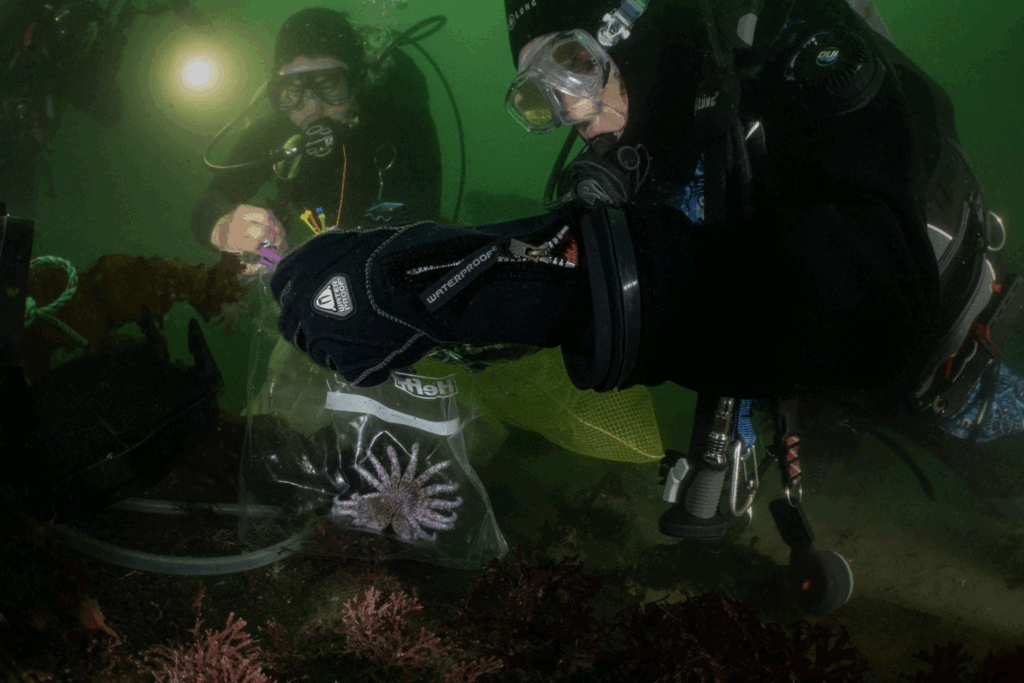
Figure 1. Divers Vince Christian and Andrew Kim of Sunflower Star Laboratory place a juvenile sunflower star into a pod in Monterey, copyright Sage Ono
In part two of this research project, 48 juvenile stars reared at Sunflower Star Laboratory and California Academy of Sciences were outplanted in the ocean in pods and monitored over four weeks, receiving regular feedings and health checks. In the one-month study, 47 out of 48 (98%) juvenile stars survived the exposure to ocean conditions—an encouraging sign for future restoration efforts in California.
This research project will inform and elevate the impact of the Association of Zoos and Aquariums’ Saving Animals from Extinction (SAFE) sunflower sea star program, as well as the Pacific Coast Ocean Restoration (PCOR) Initiative, a comprehensive, collaborative statewide strategy to restore and recover degraded marine species and ecosystems, and advances the work of the Pycnopodia Recovery Working Group (PRWG). The experiment further builds on prior trials in Washington by Dr. Jason Hodin’s team at Friday Harbor Labs and other research efforts throughout the Pacific Northwest.
“The success of this research project is a testament to the collaborative efforts of so many people working together over many years,” said Norah Eddy, Associate Director with The Nature Conservancy in California. “It’s incredible to see years of work culminating in such a successful project, and we’re excited to apply our learnings to our PCOR efforts more broadly. We’re grateful for this opportunity to work alongside our partners on restoring and recovering our marine ecosystem.”
The juveniles utilized in this study were spawned at Birch Aquarium at Scripps in 2024 and the work was conducted under permits from the California Department of Fish and Wildlife, with approvals from NOAA’s Monterey Bay National Marine Sanctuary and City of Monterey.
Media Contacts:
● Sunflower Star Laboratory |Reuven Bank, reuven@sunflowerstarlab.org
● The Nature Conservancy | Samantha Hartmann, samantha.hartmann@tnc.org
● California Academy of Sciences | Megan Ely, mely@calacademy.org
● Reef Check Foundation | Dan Abbott, dabbott@reefcheck.org
● Monterey Bay Aquarium | Emerson Brown, ebrown@mbayaq.org
● Stanford University | Jill Wu, jillwu@stanford.edu